Probability
Conditional Probability & Independence
So far we looked at the probability of a single event, and at independent events such as two coin tosses. But in real data, one thing happening often changes how likely another thing is. Conditional probability is the tool for that.
Independent vs dependent events
Two events are independent if one happening does not change the probability of the other. Two coin tosses are the classic case: getting heads first tells you nothing about the second toss.
Two events are dependent if the first one does change the probability of the second. Think of a customer who first has to open a marketing email before they can click the link inside it. The second event is conditional on the first.
Independent
No influence
The first event does not change the probability of the second.
Example: two coin tosses
Dependent
One shapes the other
The first event changes the probability of the second.
Example: open an email, then click
The conditional probability formula
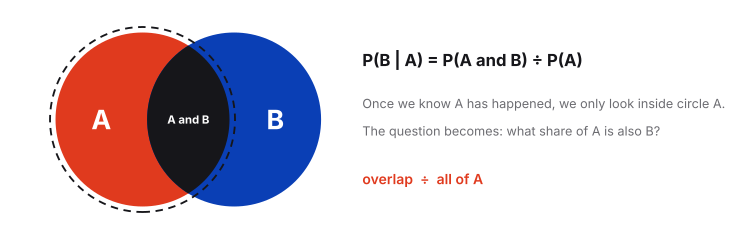
The notation P(B | A) is read as "the probability of B given A". The vertical bar means "given that": we assume A has already happened and ask how likely B is under that condition. For two dependent events:
P(A and B) = P(A) × P(B | A)
In words: the probability that both happen equals the probability of A, times the probability of B once A has happened. The same equation can be rearranged to solve for the conditional probability:
P(B | A) = P(A and B) ÷ P(A)
These are two views of one equation. Use whichever fits the information you have: the first when you know P(B | A) and want the probability of both, the second when you know the probability of both and want to isolate the condition.
Independence is a special case
If A and B are independent, knowing A tells us nothing about B, so P(B | A) = P(B). The formula then becomes P(A and B) = P(A) × P(B), which is exactly the multiplication rule from Probability Basics.
Example: drawing two hearts
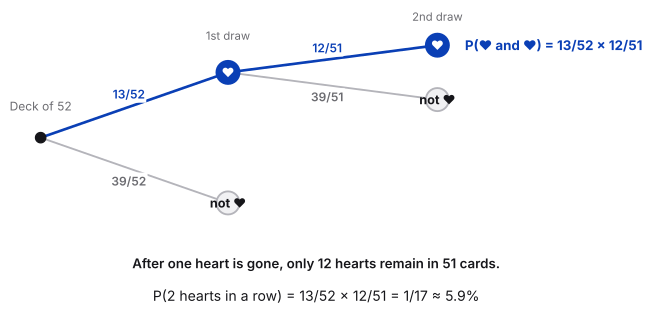
Draw two cards from a standard deck of 52, one after the other, and keep the first card out of the deck. What is the probability that both are hearts?
- First draw. There are 13 hearts among 52 cards, so P(1st heart) = 13/52 = 25%.
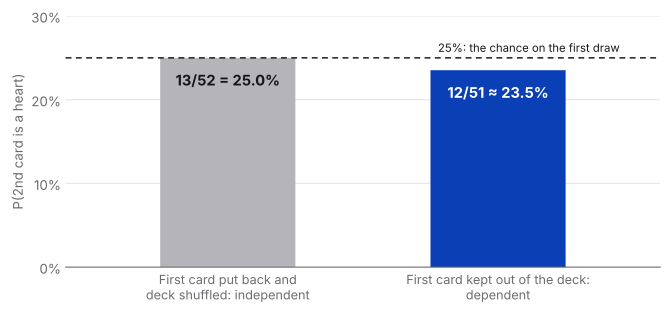
- Second draw. One heart is gone, so 12 hearts are left among 51 cards. P(2nd heart | 1st heart) = 12/51 ≈ 23.5%.
The second probability is lower than the first, which is what makes the events dependent. Putting it together:
P(2 hearts) = 13/52 × 12/51 = 1/17 ≈ 5.9%
And what if you put the first card back and shuffle? Then the deck is full again, the second draw is 13/52 once more, and the two draws are independent.
Example: an email campaign
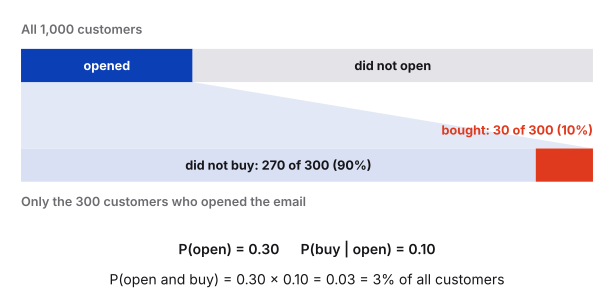
Imagine you work in e-commerce. Past data shows that 30% of customers open a promotional email, and that 10% of the customers who open it go on to buy. Buying happens after opening, so it depends on it.
P(open and buy) = P(open) × P(buy | open) = 0.30 × 0.10 = 0.03
So 3% of all customers both open the email and buy. Going the other way works too: if you only knew that 3% of customers open and buy, and that 30% open, then P(buy | open) = 0.03 ÷ 0.30 = 10%.
Don't mix up the two directions
P(B | A) and P(A | B) are different questions. "Of the customers who opened, how many bought?" is not the same as "of the customers who bought, how many opened?" The condition always decides which group you start from.
Summary of the formulas
| Situation | Formula |
|---|---|
| Both events happen (dependent) | P(A and B) = P(A) × P(B | A) |
| Probability of B given A | P(B | A) = P(A and B) ÷ P(A) |
| Independent events | P(B | A) = P(B), so P(A and B) = P(A) × P(B) |
Key takeaway
Conditional probability describes how likely an event is once we know that another one has happened. When events are dependent, the second probability changes, so we multiply P(A) by P(B | A). In business, this is how analysts estimate things like the impact of a campaign on sales, which helps stakeholders decide where to invest.